Titan RTX
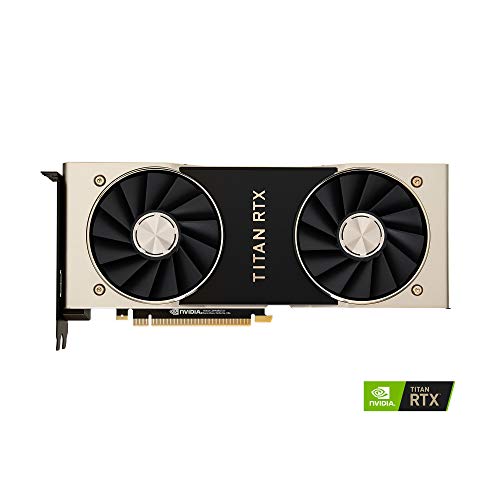
The Titan RTX is Nvidia’s 24GB graphics card with a 280W board power rating, built on the Turing TU102 architecture. Below you’ll find its full spec sheet and gaming and productivity benchmarks, plus all 1 board version we track, each with its cheapest current price.
Prices update regularly and may differ at the retailer. This page contains affiliate links.
Gaming performance
Gaming score: geometric mean of in-game FPS, normalized so the RTX 5090 = 100. Render and synthetic scores are in the Benchmarks section below.
Gaming scores are normalised performance indexes derived from Tom’s Hardware’s published GPU benchmarks. Performance per dollar and per watt are our own calculations on top of that data.
1080p Gaming
1440p Gaming
4K Gaming
The Titan RTX scores 51.2 at 1080p, 33.5 at 1440p, and 27.4 at 4K on a scale where 100 = the fastest GPU we test (RTX 5090). These scores apply to all board versions of this chip.
Performance-per-dollar rank among all GPUs with live pricing
Value at 1080p
#45
of 50
Value at 1440p
#45
of 49
Value at 4K
#42
of 46
Benchmarks
Standardized benchmark scores for this chip, each compared to the fastest card we track and linked to its source. They apply to every board version.
3D & gaming
Render
Compute & AI
Titan RTX versions (1)
Every board version we track, cheapest first.
- NVIDIA TITAN RTX$1,395.00267 mm

| Version | Boost Clock | Length | Color | From | Buy | |
|---|---|---|---|---|---|---|
| NVIDIA TITAN RTX | — | 267 mm | — | $1,395.00 | |
1 board version of the Titan RTX are listed above, starting from $1,395.00. Prices update daily from live retailer stock. Click any version name for its full spec sheet and all current retailer prices.
Specifications
Every Titan RTX board version we track measures 267 mm long.
Performance
- Boost clock
- 1770 MHz
- Base clock
- 1350 MHz
- Shader cores
- 4,608
- SM count
- 72
- Texture units (TMUs)
- 288
- Render outputs (ROPs)
- 96
- RT cores
- 72 · 1st gen
- Tensor / AI cores
- 576 · 2nd gen
Memory
- VRAM
- 24GB GDDR6
- Memory bus
- 384-bit
- Bandwidth
- 672 GB/s
- Memory speed
- 14 Gbps
- L2 cache
- 6 MB
GPU die
- Architecture
- Turing TU102
- Process node
- TSMC 12N
- Foundry
- TSMC
- Die size
- 754 mm²
- Transistors
- 18.6 billion
- Generation
- GeForce RTX 20
Power
- TDP
- 280W
- Recommended PSU
- 650W
- Power connectors
- 2 8-pin
Display & outputs
- Max resolution
- 7680 × 4320
- Max displays
- 4
- HDCP
- 2.3
- Outputs
- 1 HDMI 2.0, 3 Displayport 1.4a, 1 USB Type-C
- PCIe interface
- PCIe 3.0 ×16
APIs & software
- DirectX
- 12 Ultimate (12.2)
- Vulkan
- 1.3
- OpenGL
- 4.6
- OpenCL
- 3.0
- CUDA
- Compute 7.5
- Shader model
- 6.7
Video encoding & decoding
| Codec | Encode | Decode |
|---|---|---|
| H.264 / AVC | Supported | Supported |
| H.265 / HEVC | Supported | Supported |
| AV1 | Not supported | Not supported |
| VP9 | Not supported | Supported |
Encoder: NVENC 7th gen · Decoder: NVDEC 4th gen
Features
- Upscaling
- DLSS Super Resolution, Ray Reconstruction
- Also runs
- FSR 3, FSR 3 Frame Generation, XeSS 2, XeSS 2 Frame Generation
- Resizable BAR
- No
- Multi-GPU
- NVLink
Physical
- Reference length
- 267 mm
- Slot width
- 2 slots
- Released
- 2018-12-18
- MSRP
- $2,499.00
4,608 shader cores feed a 384-bit memory interface delivering 672 GB/s of peak bandwidth. 72 RT cores handle real-time ray tracing; 576 tensor cores accelerate AI workloads and DLSS Super Resolution. Compare the Titan RTX against the full GPU lineup on the full graphics card rankings.
Local AI performance
What the Titan RTX can run on your own machine, and how fast.
Largest model it can run (8K context)
- Q4 (the usual choice, near-original quality)
- ~32B
- Q8 (closer to original, half the model size)
- ~19B
- FP16 (unquantised, for training and research)
- ~10B
Parameter counts the card holds with room for an 8K conversation, counting the model weights plus its attention cache. A longer conversation needs more memory, so it lowers these figures.
Speed & value
- Speed, 8B model at Q4
- 93-109 tok/s
- Memory bandwidth
- 672 GB/s
- Price per GB of VRAM
- $58.13
Generation speed tracks memory bandwidth, because every word produced reads the whole model from memory. Shown as a range.
Models that fit, at Q4
| Model | Size | Memory needed | Est. speed |
|---|---|---|---|
| Llava 34B | 34.8B | 21.5GB | 22-26 tok/s |
| Yi 34B | 34.4B | 21.5GB | 22-26 tok/s |
| Nous Hermes2 34B | 34.0B | 21.6GB | 22-26 tok/s |
Popular models small enough for this card at Q4, one per family. Speed is left blank for mixture-of-experts models, where a bandwidth estimate is not reliable enough to publish.
Across generations
Where the Titan RTX sits in Nvidia’s lineup — the generation before and after.
How the Titan RTX compares
Similar cards worth a look, based on live prices and 1440p gaming performance. Open a card for its full spec sheet, or a head-to-head for the side-by-side benchmark and price breakdown.
Affiliate disclosure: Some links on this page are affiliate links — MaxMyBuild may earn a commission at no extra cost to you if you buy through them. As an Amazon Associate, MaxMyBuild earns from qualifying purchases. For Amazon, current price and availability are shown on the Amazon product page; product prices and availability are accurate as of the date and time of purchase and are subject to change. Prices shown for other retailers are approximate and may differ at checkout. “Search” links are non-affiliate and provided for convenience only.