Best PC Case for Gaming in 2026: Top Picks by Budget, Size, and Cooling
This guide contains affiliate links. If you buy through them, we may earn a commission at no extra cost to you.
The best PC case for gaming in 2026 is the Lian Li Lancool 207 (~$83). It has the best combined CPU and GPU cooling of any case in this guide: 38.1°C CPU and 38.2°C GPU above ambient under sustained load, a mesh front, and 375mm of GPU clearance. But "best" changes with your priorities. If you want the single lowest CPU temperature, that is a different case. If you are building small, that is a third. This guide breaks down the right case by budget, size, cooling priority, and noise tolerance, using real specs and benchmark data instead of marketing copy.
Some links on this page are affiliate links. If you buy through them, MaxMyBuild earns a small commission at no extra cost to you. Prices shown are approximate US retail prices from July 2026 and change frequently; check current listings before buying.
What Actually Matters When Choosing a Gaming PC Case?
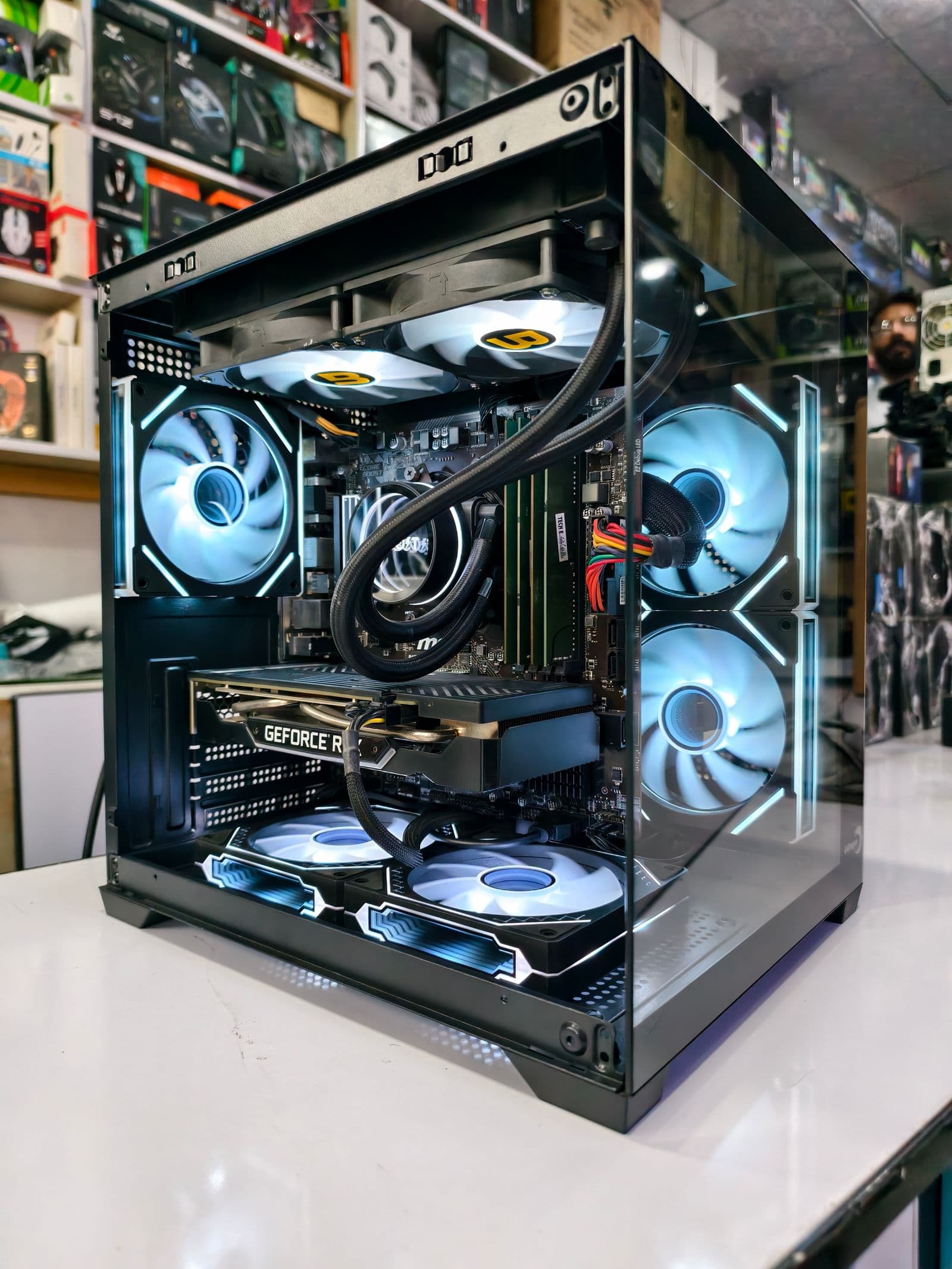
A case has one job beyond looking decent on your desk: fit your parts and keep them cool. Everything else is preference. Four things determine whether a case does that job well: compatibility, airflow, noise, and price relative to what you get.
Compatibility comes first, before cooling or looks. A case has to physically fit your motherboard's form factor, your GPU's length, and your CPU cooler's height, or the build does not go together at all. This is the check most first-time builders skip until the GPU does not fit, at the worst possible time to find out.
Airflow is the biggest lever on temperatures. A mesh front lets fans pull in cold air with minimal restriction; a solid glass front blocks a meaningful share of that intake. It is usually the difference between a GPU that stays cool under load and one that throttles. Our best airflow PC case guide breaks down the mesh-versus-glass gap in detail.
Noise is a real trade-off against cooling, not a minor detail. Cases that push more air to cool better generally do it with faster, louder fans. Decide which one you actually care about before you shop, because very few cases lead on both.
Price relative to features separates a good deal from an expensive name. A $40 case and a $250 showcase case are not competing for the same buyer, and comparing them on price alone misses the point.
Full Case Comparison: Price, Cooling, and Clearance
The table below covers cases with measured thermal data, spanning $68 to $160. CPU and GPU temperatures are degrees above ambient under sustained gaming load. Lower is better for both temperature columns. Noise is max dB at full fan speed. The budget and Mini-ITX picks below the table are chosen on price, size, and clearance because they have no independent thermal benchmark yet.
| Case | Form Factor | CPU Temp °C | GPU Temp °C | Max Noise | GPU Clearance | Price |
|---|---|---|---|---|---|---|
| Silverstone FARA 515XR | Mini-ITX/mATX/ATX | 48.4 | 51.5 | 31.8 dB | 350mm | ~$68 |
| Lian Li Lancool 207 | Mini-ITX/mATX/ATX | 38.1 | 38.2 | 41.6 dB | 375mm | ~$83 |
| Fractal Design Pop Air | Mini-ITX/mATX/ATX | 44.8 | 49.2 | 31.3 dB | 405mm | ~$90 |
| Lian Li Lancool 216 | Mini-ITX/mATX/ATX/E-ATX | 35.8 | 43.1 | 41.7 dB | 392mm | ~$96 |
| Lian Li O11 Dynamic EVO | Mini-ITX/mATX/ATX/E-ATX | 43.5 | 41.2 | 39.6 dB | 426mm | ~$160 |
Temperature delta above ambient under sustained gaming load; lower is better cooling. Prices are approximate US retail from July 2026.
The gap between the Lancool 207 and Lancool 216 tells the real story here: two cases from the same manufacturer, roughly ten dollars apart, optimized for slightly different things. The 207 balances CPU and GPU cooling almost evenly. The 216 pushes harder on CPU cooling at a small GPU cost. Neither is a wrong choice; they answer different questions.
Best Overall: Lian Li Lancool 207 (~$83)
The Lancool 207 has the best combined CPU and GPU cooling in this guide: 38.1°C CPU and 38.2°C GPU above ambient, with 41.6 dB max noise. No other case here hits this low on both numbers at the same time, which is why it is the default pick for most gaming builds.
It ships with four fans pre-installed behind a dual-layer mesh front, GPU clearance of 375mm (enough for the vast majority of RTX 5000-series cards), and 7 expansion slots for full ATX boards. At ~$83, it undercuts cases with worse thermal numbers by a wide margin.
For the deeper breakdown of how mesh-front airflow design produces these numbers, see our best airflow PC case guide.
Best Budget: Silverstone FARA 515XR (~$68)
The FARA 515XR is the cheapest case here with real measured thermal data: 48.4°C CPU and 51.5°C GPU above ambient, at 31.8 dB, with a full mesh front and 350mm of GPU clearance. It runs warmer than the Lancool 207, but it is roughly fifteen dollars cheaper and still keeps a proper airflow-first front panel, which is what matters most on a budget.
If you need to spend even less, the Cooler Master MasterBox Q300L at ~$40 is the cheapest case worth considering: a mesh front, a tempered glass side panel, 360mm of GPU clearance, and support for Mini-ITX and Micro ATX boards. Be honest about the trade-off, though. The Q300L has no independent thermal benchmark, so we cannot tell you how it actually cools relative to a measured case. Treat it as a sound budget shell, not a known-cool one, and if cooling data matters to your decision, spend the extra to move up to the FARA 515XR.
Best for CPU Cooling: Lian Li Lancool 216 (~$96)
The Lancool 216 has the lowest CPU temperature in this guide: 35.8°C above ambient, 2.3°C better than the Lancool 207. If you are running a high-TDP CPU with a large air cooler or a 360mm AIO and CPU temperature is your main concern, this is the case with the best measured result here.
The trade-off is GPU cooling: 43.1°C, meaningfully higher than the Lancool 207's 38.2°C. The 216 also has slightly more GPU clearance at 392mm and supports E-ATX boards, which the 207 does not. Pick the 216 over the 207 specifically when your build leans CPU-heavy (streaming, rendering, or a high-core-count CPU) rather than GPU-heavy.
Best Quiet Case: Fractal Design Pop Air (~$90)
The Pop Air is the quietest case in this guide with measured data at 31.3 dB max fan speed. What makes it the noise pick rather than a compromise is that it stays quiet without sealing itself off: it keeps a mesh front, so cooling lands mid-pack at 44.8°C CPU and 49.2°C GPU instead of running hot the way glass-front "silent" cases tend to. If quiet operation is the priority, swapping in low-noise case fans drops the acoustic floor further without giving up airflow.
Be clear about the trade-off against the Lancool 207. The 207 cools noticeably better (38.1°C / 38.2°C) but runs at 41.6 dB, about 10 dB louder. The Pop Air gives up a few degrees on both chips to run quieter. If a near-silent machine matters more than the last stretch of thermal headroom, and your GPU stays under roughly 250W, the Pop Air is the pick. For anything hotter, the extra noise of the 207 buys cooling you will actually want.
Best Showcase Build: Lian Li O11 Dynamic EVO (~$160)
The O11 Dynamic EVO is the case builders reach for when the goal is showing off the parts, not just cooling them. Its dual-chamber layout separates the PSU and cabling from the main compartment behind tempered glass on two sides, and it supports E-ATX boards along with 426mm of GPU clearance, the widest in this guide.
Thermals land in the middle of the pack: 43.5°C CPU and 41.2°C GPU. That GPU number is the interesting part, it is actually better than the mesh-front FARA 515XR and Pop Air, because the dual-chamber design gives the graphics card its own intake path despite the glass front. At ~$160, it costs roughly double the Lancool 207, and that premium buys the showcase layout and the extra board compatibility more than raw cooling.
Best Mini-ITX: Thermaltake TR100 (~$120)
Building small changes the math. The TR100 is a dedicated Mini-ITX case with 360mm of GPU clearance, enough for most RTX 5070-class cards in their standard length, and three expansion slots for a triple-slot cooler if your GPU needs one.
The number that actually decides whether this case works for you is CPU cooler height: just 68mm. That rules out every tower air cooler on the market. Plan around a low-profile air cooler or a compact 240mm/280mm AIO instead, and check clearance against your specific cooler before buying; our best CPU cooler guide breaks down cooler heights by case fit.
One honest caveat: dedicated small-form-factor cases like the TR100 have no independent thermal benchmark, so pick it on fit and size rather than on measured cooling, and rely on good fan placement and a well-sized cooler. If you want a roomier, more finished SFF option and do not mind paying more, the Fractal Design Terra (~$200–230) is the premium alternative, though it has less GPU clearance at 322mm.
Case Compatibility: What to Check Before You Buy
Not every case here takes a full ATX board. The small-form-factor picks, the Thermaltake TR100 and Fractal Terra, are Mini-ITX only, and the Cooler Master Q300L tops out at Micro ATX. Everything else supports standard ATX. Beyond the board, GPU clearance and CPU cooler height limits are where builds actually go wrong, so measure your GPU's length (from the box or the manufacturer's spec page) and your cooler's height, then compare against the case before ordering either part.
| Case | GPU Clearance | CPU Cooler Max Height | Expansion Slots |
|---|---|---|---|
| Lian Li O11 Dynamic EVO | 426mm | 167mm | 8 |
| Fractal Design Pop Air | 405mm | 170mm | 7 |
| Lian Li Lancool 216 | 392mm | 180.5mm | 7 |
| Lian Li Lancool 207 | 375mm | 180mm | 7 |
| Thermaltake TR100 | 360mm | 68mm | 3 |
| Cooler Master MasterBox Q300L | 360mm | 159mm | 4 |
| Silverstone FARA 515XR | 350mm | 159mm | 7 |
| Fractal Design Terra | 322mm | 77mm | 3 |
The TR100 and Terra stand out for a reason: both are dedicated small form factor cases, and both cap CPU cooler height under 80mm. That is normal for the category, not a flaw, but it means your cooler choice has to match the case first. For everything else in this table, cooler height in the 159–180mm range covers the large majority of tower air coolers on the market.
For a full walkthrough of measuring your specific GPU against case clearance, see the GPU size and case clearance guide.
Which PC Case Should You Buy?
Five scenarios cover most gaming builds:
Most builds: Lian Li Lancool 207 at ~$83. Best combined CPU and GPU cooling in this guide, mesh front, broad compatibility. Start here unless one of the categories below applies to you specifically.
Tight budget: Silverstone FARA 515XR at ~$68 for the cheapest case with verified thermal data, or the Cooler Master MasterBox Q300L at ~$40 if you need to go lower and can accept that its cooling is unmeasured.
Quiet build: Fractal Design Pop Air at ~$90. The quietest measured case here at 31.3 dB, and mesh, so it stays quiet without running hot.
Small form factor build: Thermaltake TR100 at ~$120, paired with a low-profile cooler or compact AIO. Step up to the Fractal Design Terra if you want more finished SFF design and can spend more.
CPU-heavy workloads: Lian Li Lancool 216 at ~$96. The lowest CPU temperature measured in this guide, worth the small GPU cooling trade-off for streaming, rendering, or high-core-count builds.
If you are still deciding between components, the PC Builder at MaxMyBuild matches your budget to a fully compatible parts list with live retail pricing, including a case sized correctly for your GPU and motherboard from the start.